
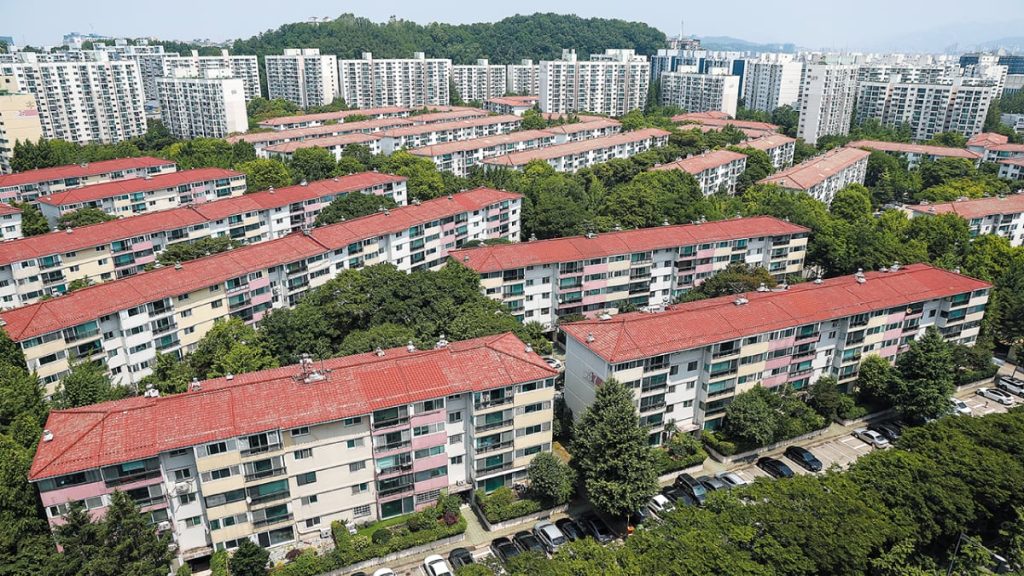
Surge in Urban Renewal Contracts for South Korean Construction Giants
In an impressive display of growth, South Korea’s ten largest construction firms secured urban renewal contracts exceeding 27 trillion won (approximately $19.5 billion) in the first half of 2025. This remarkable figure accounts for over 98 percent of the total amount achieved in the entire previous year, marking a significant uptick in industry activity. With several major bids still on the horizon for the latter half of the year, experts predict that the total for 2025 could reach unprecedented levels.
Leading Firms and Their Performance
Samsung C&T Corporation’s Construction Division emerged as the frontrunner in the first half of the year. Notably, the firm clinched a redevelopment contract worth 1.57 trillion won ($1 billion) for the Hannam District 4 project in January. This was followed by substantial contracts for the Sinbanpo Phase 4 project (1.03 trillion won) and the public redevelopment of Jangwi District 8 (1.19 trillion won). Should Samsung secure the upcoming Ulsan Nam District B-04 redevelopment project, expected to be announced in late June, its total contracts for the first half could soar to 5.72 trillion won ($4.2 billion), representing a staggering 55.5 percent increase from the previous year’s 3.64 trillion won.
Hyundai Engineering & Construction Co. also delivered strong results, securing 1.51 trillion won for the reconstruction of the Gaepo Jugong Apartment Complexes 6 and 7 in May. Additionally, the company won a 1.96 trillion won redevelopment project in Sutaek-dong, Guri, which is touted as the largest of its kind in South Korean history. This brought Hyundai’s first-half total to 5.54 trillion won ($4 billion). Other notable firms included POSCO E&C at 5.03 trillion won, Lotte E&C at 2.95 trillion won, and DL E&C at 2.68 trillion won, with each of the top five firms exceeding 2 trillion won in urban renewal orders during the six-month period.
Market Dynamics and Challenges
Urban redevelopment and reconstruction projects have long been considered lucrative contracts in the construction sector, primarily due to their large scale and strategic locations. These factors significantly reduce the risk of unsold units. However, the industry has faced challenges in recent years, including skyrocketing construction costs that have imposed financial strains on both residents and developers. This situation has led many firms to exercise caution, scaling back their pursuit of such projects.
The tide appears to be turning in 2025. Following a prolonged slump in the construction market and a decrease in public-sector infrastructure contracts—intensified by political events such as last year’s presidential impeachment and this year’s general election—private-sector urban renewal is witnessing a resurgence. Analysts attribute this renewed interest to rising housing prices in Seoul and a persistent shortage of new supply in the capital region.
A report from the Korea Research Institute for Construction Policy indicated that the construction progress payment amount—a vital real-time indicator of industry health—was recorded at 26.87 trillion won ($19.7 billion) in the first quarter of 2025, down 21.2 percent from the previous year. This metric reflects the value of work completed on ongoing projects and indicates a significant decline in active construction volume.
Strategic Shifts in Project Selection
Construction firms are becoming increasingly discerning in their project selections, emphasizing profitability over sheer volume. Instead of competing in non-metropolitan areas where there is a growing inventory of unsold properties, companies are directing their bidding efforts towards the Seoul metropolitan area. During tender processes, firms are more frequently opting out of bids for sites that do not meet prime location criteria.
Industry experts caution that the escalating costs associated with financing, relocation assistance, and marketing may lead to situations where project expenditures surpass anticipated returns. Lee Eun-hyung, a senior researcher at the Korea Research Institute for Construction Policy, emphasized the impact of urban renewal policies from previous administrations, stating, “We are witnessing the fruition of these initiatives as large-scale bids begin to materialize this year. With limited new housing supply in the capital and an increasing number of aging apartment complexes, the demand for redevelopment, reconstruction, and remodeling projects is likely to persist.”
As the construction landscape evolves, the focus on high-value urban renewal contracts is expected to reshape the industry, driving growth and investment in the coming years.